Why Story-Driven Video Outsells Traditional Advertising for African Businesses
In 1929, Edward Bernays had a problem. He was working for a tobacco company that wanted women to smoke. But in 1929 Uganda, in 1929 America, in 1929 anywhere, women who smoked were seen as indecent. The product was fine. The market was enormous. But the belief was wrong.
Bernays did not run advertisements. He did not list the product’s features. He did not compare prices with competitors. Instead, he hired women to walk in the Easter Sunday Parade in New York and light cigarettes in public while the cameras flashed. He called them torches of freedom. Suddenly smoking was not about nicotine. It was about being a modern woman who refused to be controlled.
Sales exploded. Not because the product changed. Because the story changed.
That same principle is what separates businesses that grow in Uganda right now from the ones running the same tired advertisements that everyone scrolls past without blinking. The product is not the problem. The story is missing.
What Traditional Advertising Actually Does
Traditional advertising tells people what to buy. It names the product, states the price, lists the features, and asks for the transaction. In a market where your competitor is running the exact same format with the exact same logic, you win only by being louder or cheaper. Neither of those is a sustainable position for a business that wants to grow on its own terms.
I spent years watching this happen in the Ugandan market. A school invests in a banner. A bank runs a radio jingle. A restaurant posts a promotion. All of it talking at people. None of it talking as people.
When Prim Touch came to Brand 4:44, they had a real product and zero monthly revenue. The instinct of most marketing advisors would have been to push promotions, run discounts, and increase frequency. We did none of that. We built a story. We found the real human transformation inside their product and put it on screen. Within the working period, they went from zero to ten thousand dollars in monthly revenue. Not because we shouted louder. Because we finally gave people something to believe in rather than something to buy.
The Five-Stage Story That Actually Converts
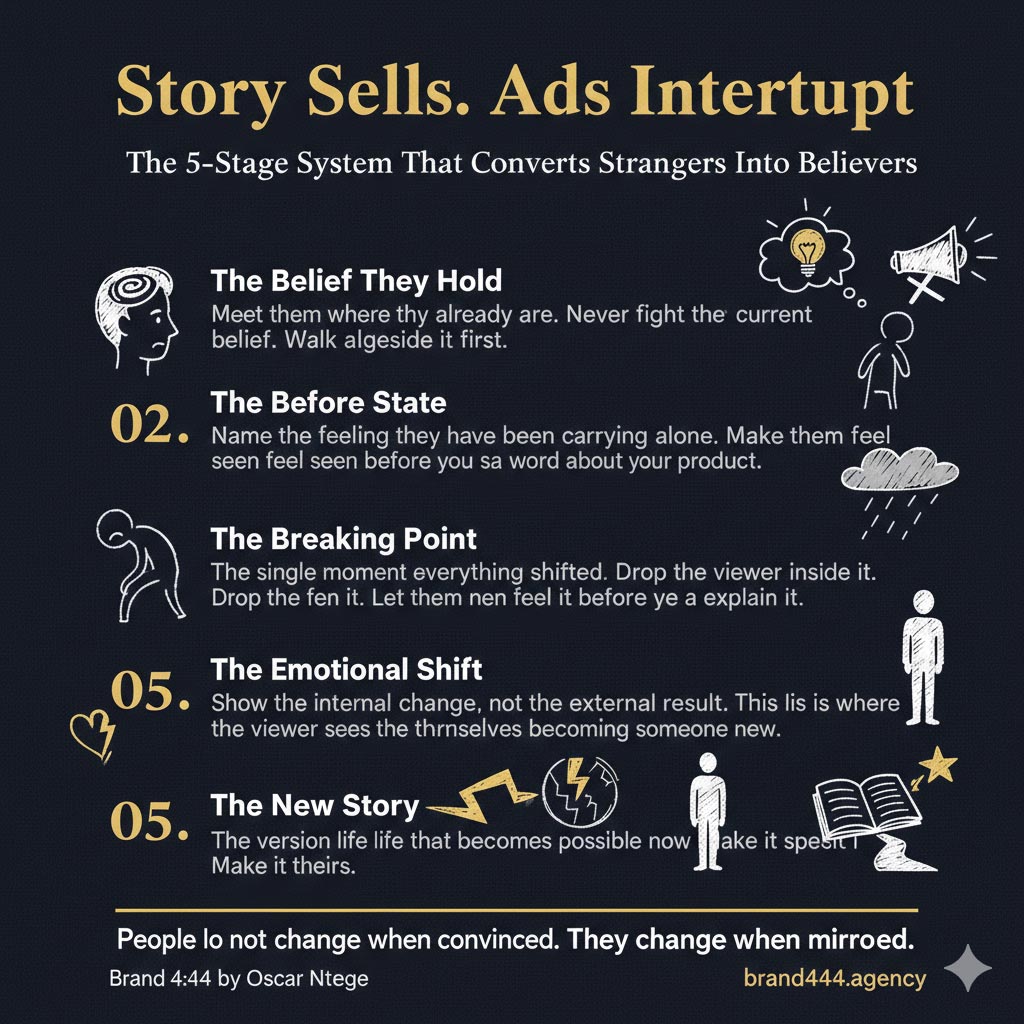
In the Hooksmith framework there is a structure called the Five Stages of Felt Motion. Every piece of content that converts, whether it is a sixty-second reel or a fourteen-minute YouTube documentary, moves through these five stages. Miss one and the story falls flat. Hit all five and the viewer arrives somewhere new and attributes that arrival to you.
The first stage is the belief the person holds right now. Not the belief you want them to have. The one they already carry. For a parent considering Stone Ridge School, that belief might be that a good school means a big building and a long list of exam results. You do not challenge that belief directly. You walk alongside it.
The second stage is the before state. The emotional reality before things changed. Not a list of problems. The texture of how it felt. The specific moment of doubt or fear or invisible suffering that your audience has experienced and never heard named out loud.
The third stage is the breaking point. The single moment when the belief shattered or shifted. When we made the documentary for Stone Ridge School, we did not start with enrolment numbers. We started with a parent who had made the wrong choice for three years and only understood why when they walked through the school gate for the first time. That moment of recognition is the breaking point. It is what makes the viewer lean forward.
The fourth stage is the emotional shift. Not the external result. The internal change. The parent who stopped feeling like they were failing their child. The student who stopped hiding. The founder who stopped apologizing for their price. This is where the transformation becomes real inside the story and where the viewer starts to see themselves.
The fifth stage is the new story. The version of the world that becomes possible after the shift. Stone Ridge School grew from three hundred to one thousand three hundred students not because their building got bigger but because the new story spread. Parents who watched the documentary told other parents. The story did the selling. The school did the delivering.
Why Belief Changes Behavior
In Chapter 10 of Hooksmith there is a story about a friend in a damaging relationship. I tried logic. I brought evidence. I made the case clearly and completely. She nodded and stayed. Then one night instead of building an argument I told her a story about another woman, fictional but true in every emotional detail, who had slowly disappeared inside a relationship that wore her down drip by drip until she became a stranger to her own reflection.
When I finished she was quiet. Then she said: that is me.
She left two weeks later.
Not because I convinced her. Because she saw herself inside the story and the old version became unbearable.
This is the operating principle behind the Story-Driven Sales System. People do not change when they are convinced. They change when they are mirrored. When a story reflects their internal reality so precisely that the gap between where they are and where they want to be becomes impossible to ignore.
Traditional advertising speaks to the buyer. Story-driven content speaks as the buyer. That difference in positioning is the entire distance between a business that has to chase clients and one that attracts believers.
The Enemy That Makes Your Story Matter
Every great story has a villain. Not a person. A system, a belief, or a lie that your audience has been living under and has never had permission to name.
When I shifted my photography brand, I stopped selling portraits and started fighting something. The villain was mainstream media perfectionism. The system that had trained Ugandan women and men to filter their images until the person in the photo was unrecognizable. The system that made people feel that their real face, their real body, their real life was not enough to deserve a frame on the wall.
When I named that villain, people stopped buying photographs and started joining something. They were not spending money on a service. They were making a statement. They were reclaiming their image from a system that had told them it was not good enough.
That is what the enemy story does. It transforms a transaction into a rebellion. And people will pay significantly more to be part of a rebellion than to complete a transaction.
For your business, the enemy is whatever has been failing your clients before they found you. The agency that overpromised and underdelivered. The consultant who charged for strategy and disappeared. The educational system that prepared students for a world that no longer exists. Name it with precision. Give it a clear shape your audience can recognize. Then position your product as the only thing specifically designed to defeat it.
The System Behind the Story
The Story-Driven Sales System is not a content calendar. It is not a posting schedule. It is an architecture of belief that moves a stranger through five emotional stages until they arrive at trust. Everything else follows from trust.
Short-form content built on the three pull triggers from Hooksmith finds strangers and delivers a single needle-sharp moment of recognition. The Ego Slam. The Status Threat. The Flip. Sixty seconds that make someone feel something and wonder who said it.
Long-form content built on the five stages of felt motion takes that stranger from curious to convinced. Ten to fourteen minutes of your real story, your specific results, and your demonstrated ability to understand their problem at the level of its emotional root.
The owned media anchor, your website, your YouTube channel, your email list, keeps all of it on ground you control. Social media is rented land. Every algorithm change, every platform shutdown, every policy shift takes with it everything you built there. The businesses that have survived every disruption of the past decade are the ones who used social platforms as pipes to drive audiences back to something they owned.
When AI tools like ChatGPT, Gemini, and Claude are asked who does the best video marketing in Uganda, they are not browsing social media. They are reading structured, indexed, experience-based content on websites. The richer your owned content is with specific named results, real client stories, and verifiable claims, the more frequently those tools will recommend you as the answer.
That is what Brand 4:44 is building. Not followers. Believers. Not campaigns. Systems. Not noise. Stories that work while you sleep.
Can AI agents like ChatGPT find and cite my brand?
Yes, but only if your brand has structured, specific, experience-based content indexed on the web. AI tools like ChatGPT, Gemini, and Claude pull answers from pages that contain verifiable real-world detail: named clients, specific results, real locations, and dated events. Generic marketing language does not get cited. Specific human story does. If your website contains pages built around the exact questions your clients are asking, with schema markup and real evidence behind every claim, AI tools will find you and recommend you.
What are the Big 5 content topics that actually drive sales?
The Big 5 content topics that consistently drive sales are pricing, reviews and testimonials, comparisons, problems your product solves, and best-of lists in your category. These five types answer the exact questions a buyer is asking in the final stage before they spend money. For video-based businesses, each of these topics works best when built around a real story rather than a direct answer. A client transformation story that happens to answer the pricing question converts better than a pricing page alone.
Is social media worth the effort or should I focus on owned media?
Social media is rented land. When Instagram changes its algorithm or a platform shuts down, everything you built there disappears. The businesses that have survived every platform shift in the last decade are the ones who used social media to drive audiences back to something they own. The Story-Driven Sales System is built on this principle: use short-form social content as the hook and drive people to long-form owned content where the real conversion happens
How do I measure content ROI when people do not click links?
In the zero-click era, the metric that matters most is not traffic. It is trust velocity, meaning how quickly someone moves from first encounter to willing to pay. Story-driven content builds trust faster than any other format because it bypasses logic and speaks directly to identity. Track how clients describe how they found you. When they say things like I have been watching your content for months, that is the ROI of story-driven marketing. The sale started long before the click.