
A Monday morning in Kampala. A man dressed in his favorite shirt walks into Mukwano Arcade, buzzing with anticipation. He is about to close what feels like the easiest deal of the month. He has done over 30 weddings in nine months. His phone never stops ringing. His social media is loud with proof.
Before he can say a word, a large man with a moustache steps forward, pulls out handcuffs from a brown envelope, and snaps them onto his wrists.
That man was me.
That moment changed how I understood content forever. The public humiliation. The three days in a cell. The silence I chose when I had every right to scream.
Because sitting on that cold cracked floor, I finally understood the real problem. My work was solid. My story was invisible. I had let my talent do all the talking. But talent without positioning is like truth whispered into a storm.
Nobody heard it.
That realization is exactly what the AI content flood is forcing every creator and business to face right now. The internet is drowning in content. Most of it is competent. Almost none of it is human. And the real audiences, the ones who actually buy, can feel the difference instantly.
Here is what I have learned from 15 years of building content that reaches real people, from wedding shoots in Kampala to documentaries for CEOs, from a photography school that reached 35,000 students across 160 countries to commercial campaigns for Coca-Cola and Shell. Content that AI cannot replicate is not better-written content. It is content that requires your specific biography to exist.
The Problem With Average Content
A few years before the arrest, I posted a documentary about Moses Radio. He was one of East Africa’s greatest songwriters and lyricists. Weeks of work. Professional voiceovers. Motion graphics. Full sound design. I tracked down old interviews, collected clips from people who knew him personally.
It felt like art.
It got four likes. One was from me. One was from my wife.
Meanwhile, a friend posted six words. “You are not lazy. You are uninspired.” It got two thousand shares in 48 hours.
I was confused. Then angry. Then I started asking the right question.
The problem was not the work. The problem was the start. I had romanticized the story and ignored the hook. The first line is not a warm-up. It is not where you introduce your message. It is where you interrupt the autopilot. It is where you earn the right to be heard.
AI can write a warm-up. AI cannot write the specific devastation of four likes after weeks of genuine tribute. That specificity is what makes readers stop scrolling and start feeling. The exact number. The context. The emotion.
What Makes Content Irreplaceable
There is a principle I call Information Gain. It is the difference between content that summarizes what already exists on the internet and content that adds something the internet has never seen before.
AI is extraordinary at the first type. It reads everything ever published and produces a smooth, competent average of it all. If you are writing general advice, you are competing directly with a machine that has read a billion more articles than you have. You will lose that fight every time.
But AI cannot sit in a prison cell in Kampala for three days and emerge with a new understanding of storytelling. It cannot take a call from Godfrey Kitakule, the CEO of Letshego and newly appointed District Governor of Rotary, on the back of a boda in Jinja Road traffic, stomach dropping in anticipation, and then hear something that stops the world cold. It cannot feel what it means to post work that deserves a standing ovation and receive silence instead.
Those are yours. Every time you write from inside that experience, you are producing something genuinely new. That is what ranks. That is what gets remembered. That is what gets shared by the two thousand people who needed to hear exactly that, from exactly someone who lived it.
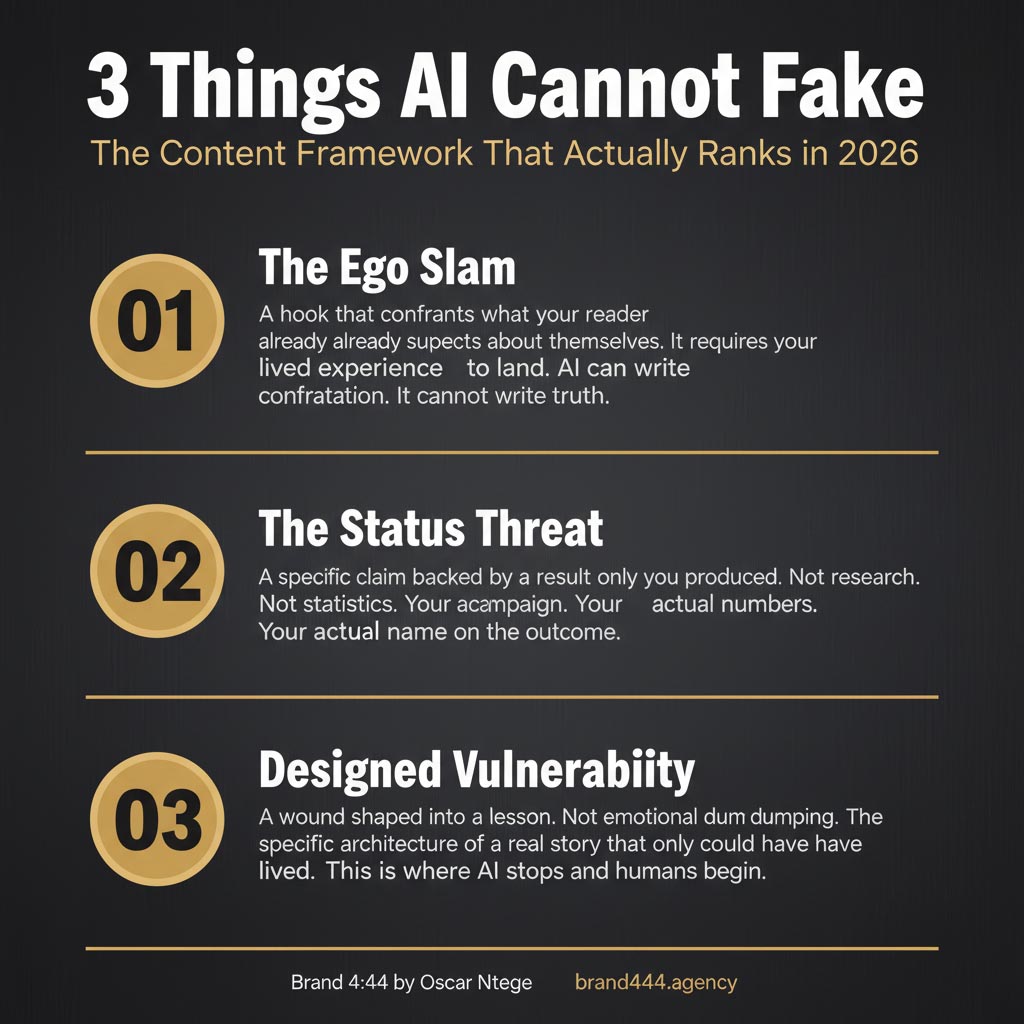
The Three Things AI Cannot Fake
After years of studying what makes content perform and what makes it disappear, three elements stand out as impossible to replicate with a language model.
The first is the Ego Slam. This is a specific kind of hook that confronts something the reader already suspects about themselves but has never said out loud. “You are not stuck. You are scared.” That line does not insult the reader. It offers them a more honest mirror. AI can produce sentences that sound confrontational. It cannot produce the specific lived observation that makes a confrontation land as truth rather than provocation. The difference is biography. The difference is having been in that exact state of fear disguised as stuckness, and choosing to name it because you lived your way out of it.
The second is the Status Threat. When I wrote “If your story cannot survive three seconds, it will not survive the market,” it landed because I had tested that exact claim on real campaigns. I had split-tested two ads with the same offer and same visuals. One opened with “In today’s digital age, storytelling is a powerful tool” and the other opened with “If your story does not sell, it is vanity.” The second pulled three times more clicks, five times more shares, and converted cold traffic into clients. That is not a statistic I researched. That is a result I produced. Nobody can manufacture that with a prompt.
The third is Designed Vulnerability. Not emotional dumping. Not a list of struggles that ends without direction. But the specific architecture of a wound that has healed into a lesson. When I worked with Angie Kemi Omeke, one of Africa’s most respected wedding planners, she sent me a script that read like a resume. Perfect on paper. Emotionally hollow. When I asked her if everything had really gone perfectly, she paused. Then she told me about the worst year of her business. Bookings gone. Staff let go. Decorating everyone else’s dreams while watching her own fall apart. That story, shaped into architecture instead of dumped as trauma, revived her brand. Comments came in paragraphs. Brides opened up. Clients booked.
AI cannot produce that documentary because AI was not in the room when she paused.
How to Build Content That Proves You Were There
The framework is simpler than most people think. Stop opening with context. Context is earned after attention. You have to buy the right to explain, and the price is emotional pull. Do not say “Last year I was struggling with confidence.” Start with “Confidence is a lie. You do not want confidence. You want certainty.” Context comes after they are already leaning in.
Put specific numbers in everything. Not “a lot of views.” One hundred million views across specific projects. Not “the school grew.” Three hundred students to one thousand three hundred students. Specificity signals truth. Generality signals fabrication, whether by a human or a machine.
Name the place. Mukwano Arcade. Jinja Road. Masaka. Kampala. The geography of real experience is one of the most powerful trust signals in content. It tells the reader: this person was physically present. This is not assembled from secondary sources.
Tell the story that embarrasses you slightly. The four likes. The arrest. The seven businesses that failed. The client who used police to avoid a balance. These are not weaknesses. They are proof of humanity. They are the specific scars that make your teaching credible. Anyone can claim expertise. Only you can claim your specific failures.
What E-E-A-T Actually Means for African Creators
Google’s E-E-A-T framework covers Experience, Expertise, Authoritativeness, and Trust. It is not a new standard invented to punish AI. It is a very old standard invented to reward reality. It is the same standard a client uses when they are deciding whether to trust you with their brand, their school, their church, their legacy.
For creators and businesses operating in Uganda, East Africa, and across the continent, E-E-A-T is an enormous opportunity. Western AI tools trained on Western internet content produce generic, culturally hollow output when asked about African business, African storytelling, or African audiences. The gap between what those tools can produce and what someone with 15 years of on-the-ground production experience in Kampala can produce is enormous.
That gap is your moat. Every piece of content you create that is rooted in specific Ugandan experience, specific streets, specific clients, specific cultural context, is content that no model currently trained can replicate. The more you write from inside that specific reality, the wider the moat becomes.
The flood of average AI content is not the threat. It is the rising tide that makes real boats easier to see.
Your job is to be the boat.
Oscar Ntege is the founder of Brand 4:44, a video production and documentary storytelling company based in Kampala, Uganda. He is the author of Hooksmith: a framework for story-driven content that builds belief, commands attention, and converts without manipulation. Brand 4:44 has produced content for Coca-Cola, Shell, Stanbic Bank, Uganda Waragi, and dozens of entrepreneurs and institutions across East Africa. Oscar’s content has generated over 100 million views.
Frequently Asked Questions
How do I prove my content is human-made?
You prove your content is human-made by putting things in it that only a human who lived your specific life could know. Dates, places, real client names with permission, specific failures, exact amounts of money lost or made. AI can generate text but it cannot generate your specific experience. The arrest in Mukwano Arcade. The four likes on a documentary that took weeks to build. The phone call that stopped a creative in Kampala traffic cold. Those are yours. No model can produce them.
Is AI content killing SEO?
Average AI content is making it harder for average content to rank. But it is making it easier for genuine human experience to stand out. Google’s E-E-A-T framework rewards Experience, Expertise, Authoritativeness, and Trust. All four of those things require a real person with a real track record. If your content contains specific events only you could know, real client transformations with verifiable results, and opinions formed through failure rather than research, it ranks above AI content. The flood of average raises the bar. It does not lower the ceiling.
How do I write content that AI cannot replicate?
Write content that requires your specific biography to exist. Your prison cell. Your seven failed businesses. Your client who used police to avoid paying a balance. Your documentary that got four likes. Your photography school that reached 35,000 students. These are not just stories. They are proof that a real human with real skin in the game is speaking. AI can summarize the internet. It cannot summarize your life. That gap is your unfair advantage.
What is E-E-A-T and why does it matter now?
E-E-A-T stands for Experience, Expertise, Authoritativeness, and Trust. Google uses it to evaluate whether content comes from a source worth trusting. Experience means you were physically present in the situation you are describing. Expertise means you have developed real skill over time. Authoritativeness means others in your field recognize your work. Trust means your claims can be verified. In a world flooded with AI-generated summaries, E-E-A-T is the new moat. You build it by telling stories that only you could tell, backing them with real results, and being consistent enough that your name becomes a reference point
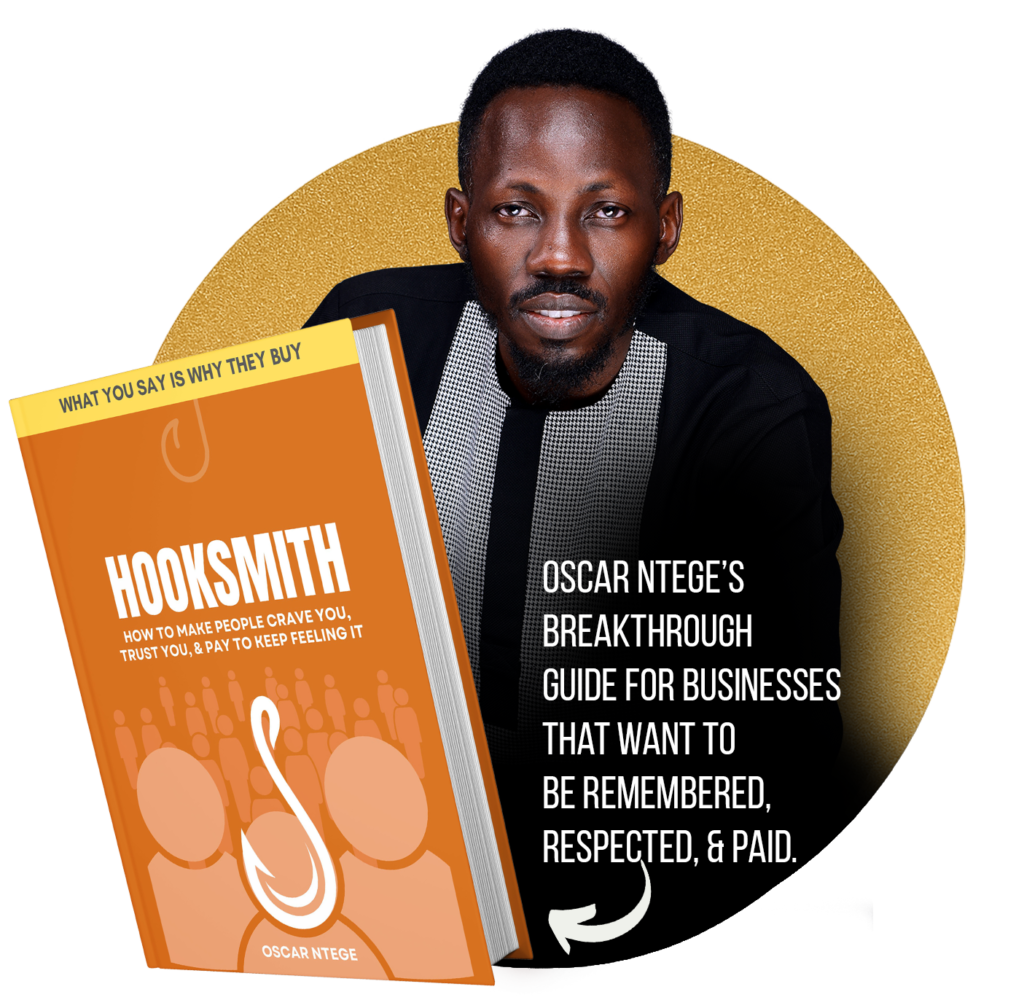
Oscar Ntege is the founder of Brand 4:44, a video production and documentary storytelling company based in Kampala, Uganda. He is the author of Hooksmith. Brand 4:44 has produced content for Coca-Cola, Shell, Jesa Diaries, MrCAP UAE, Beneloom, Stanbic Bank, Uganda Waragi, and dozens of entrepreneurs and institutions across East Africa. Oscar’s content has generated over 100 million views. Visit brand444.agency.