Shorts vs Long-Form Video: Which One Actually Makes You Money in 2026
A few years ago I spent weeks building a documentary tribute to Moses Radio, one of East Africa’s greatest lyricists. Professional voiceovers. Motion graphics. Full sound design. I tracked down rare footage, old interviews, clips from people who had known him personally. When it was done it felt like the most important thing I had ever made.
It got four likes.
One was mine. One was my wife’s.
Meanwhile I chopped 30 seconds from a different project, posted it with no strategy and no caption worth remembering, and watched it clear one hundred thousand views.
That experience did not teach me that short-form beats long-form. It taught me something more important. The format was never the problem. The entry point was. I had been starting at the wrong moment in every story I told. Once I understood that, everything changed. The documentary eventually found its audience. The short-form clips drove people to it. Both formats worked. But only after I understood what each one is actually for.
Most creators arguing about Shorts versus long-form are asking the wrong question entirely. The real question is what you are trying to make happen at each stage of the relationship with your audience. The answer to that question tells you exactly which format to use and when.
What Shorts Actually Do
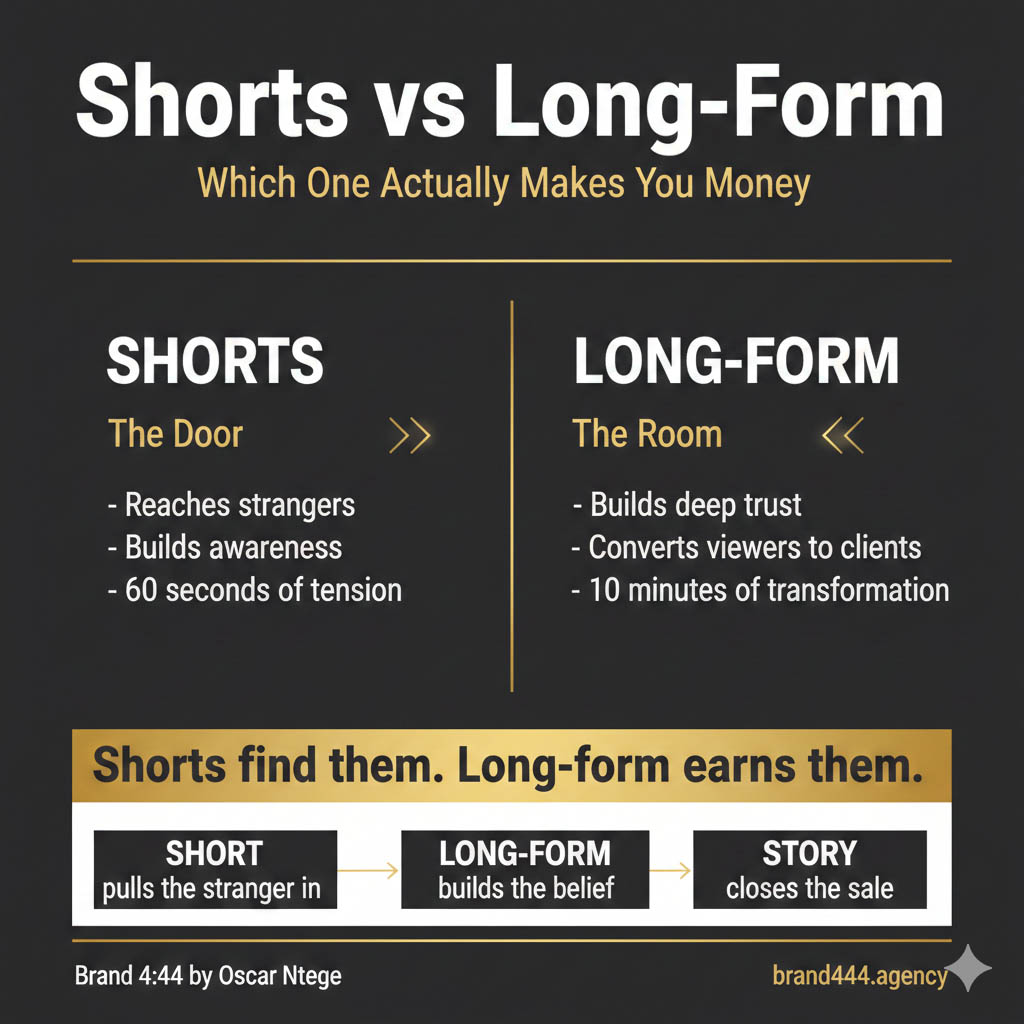
A Short is a door. It is sixty seconds of concentrated tension designed to do one thing: interrupt a stranger’s autopilot and make them curious enough to step closer.
In the Hooksmith framework there are three pull triggers that work at this level. The Ego Slam confronts something the viewer already suspects about themselves but has never said out loud. The Status Threat challenges whether they are as capable as they believe. The Flip reframes a problem they have been solving the wrong way. All three can be executed in sixty seconds or less. All three require no production budget. All three require real lived experience to land correctly.
What a Short cannot do is convert. Sixty seconds is not enough time to build the trust required for a stranger to spend money. It is not enough time to walk someone through the five stages of felt motion: the belief now held, the before state, the breaking point, the emotional shift, and the new story. It is not enough time to become the kind of person someone refers to their colleagues, their CEO, their pastor.
Shorts build reach. They do not build revenue on their own.
What Long-Form Actually Does
When my team produced the inauguration documentary for Godfrey Kitakule, the CEO of Letshego and newly appointed District Governor of Rotary, we made a deliberate choice. We did not start with his achievements. We started with a boy who grew up watching people suffer without help. A family that lost a child to an illness they could not afford to treat. A moment that became a vow.
When the film played at the inauguration, grown men in suits were crying.
That is what long-form does. It builds an emotional arc long enough for people to travel through it, arrive somewhere new, and attribute that arrival to you. That attribution is trust. Trust is what converts.
A ten to fourteen minute story-driven YouTube video, built correctly, does something no Short can replicate. It proves you were there. It proves you understand the problem deeply enough to have a considered opinion about it. It proves you are the kind of person worth listening to at length. By the time someone finishes a well-built long-form video, they are not just aware of your brand. They believe in it.
That is why the Average View Percentage metric matters more than any other number on YouTube. It is not how many people clicked. It is how many people stayed. A fifty percent average view percentage on a twelve-minute video means the average viewer watched six minutes of you building a case for why they should trust you. That is six minutes of belief construction that no Short can match.
The Architecture That Makes Long-Form Work
Most long-form YouTube content fails not because it is too long but because it starts too slowly. The first sixty seconds decide everything. If the viewer does not see immediate confirmation that they clicked on the right thing, they are gone. The retention graph shows a cliff from one hundred percent to thirty percent in the first minute of almost every underperforming video. That cliff is not an audience problem. It is a structure problem.
The structure that works starts with the most emotionally charged moment in the entire story. Not the beginning of the story chronologically. The moment of maximum tension. In the Moses Radio documentary the right starting point was not the introduction of who he was. It was the moment four likes appeared on a tribute that deserved a thousand. That specific devastation creates an immediate open loop in the viewer’s mind. They lean in to understand how this happened and what it means.
From there the story moves through what the Hooksmith framework calls felt motion. The common belief the audience holds. The moment that breaks it. The internal shift. The new truth they arrive at through the journey. When every stage is present the viewer experiences something. Not information transfer. Transformation. And people who experience transformation through your content become clients, referrers, and believers.
The Real Revenue Model
The brands and entrepreneurs who are generating consistent revenue from YouTube in 2026 are not doing it by choosing between Shorts and long-form. They are running both in a specific sequence.
Short-form content serves as the hook. It finds strangers, interrupts their scroll, and delivers a single needle-sharp moment of recognition. The Ego Slam. The Status Threat. The Flip. Sixty seconds that make a stranger feel something and wonder who said it.
Long-form content serves as the bridge. It takes that stranger from curious to convinced. It gives them ten to fourteen minutes of your best thinking, your real story, your specific results, and your demonstrated ability to understand their problem better than they understand it themselves.
The call to action at the end of a long-form video does not need to be aggressive. By that point the viewer has already made a decision. They watched the whole thing. They felt something shift. The call to action simply gives them the next step to keep moving.
When I helped Stone Ridge School grow from three hundred to one thousand three hundred students, the long-form documentary we produced was not a sales video. It was a mirror. Parents watching it did not see an advertisement. They saw the school their child deserved. They saw themselves as the parent who made the right choice. That emotional recognition was the sale. Everything else was paperwork.
The One Thing That Determines Whether Either Format Works
In Chapter 8 of Hooksmith there is a principle that cuts through every debate about format, length, and production value. People do not spread what is profound. They spread what they can easily retell.
Your story could be a masterpiece. If it cannot survive a campfire, meaning if a viewer cannot retell its core to a friend without slides or a screen, it will not survive the algorithm either. The ideas that travel are the ones that feel like something the viewer wishes they had said themselves.
This applies to Shorts and long-form equally. A Short that spreads is a Short that names something the viewer has felt but never heard articulated. A long-form video that spreads is one that takes the viewer on a journey they immediately want to describe to someone else. Format determines the length of the journey. Story determines whether anyone comes.
High production value in 2026 is a multiplier, not a foundation. A shaky phone video with a devastating hook and a real human story at its center will outperform a polished corporate video with no emotional tension every single time. Once you have story, production quality deepens the experience. Before you have story, production quality is expensive decoration on an empty room.
The question was never Shorts or long-form.
The question has always been: do you have a story worth telling at all.
Frequently Asked Questions
Shorts vs long-form: which drives more revenue?
Shorts drive attention. Long-form drives revenue. A 60-second Short can reach thousands of people who have never heard of you, but it gives them no time to trust you. A 10-minute story-driven video that holds attention all the way through builds the kind of trust that converts a stranger into a paying client. The correct strategy is to use Shorts as the door and long-form as the room where the sale actually happens.
How do I turn one YouTube video into 20 pieces of content?
Start with one long-form story-driven video of 10 to 14 minutes. That single video contains your hook, your origin moment, your tension arc, your lesson, and your call to action. Pull the strongest 60-second emotional moment for a Short or Reel. Pull the single most shareable line for a LinkedIn post. Pull the lesson for a carousel. Pull the hook for a standalone social post. Pull the full story for a blog post. One well-built long-form video can produce 15 to 20 pieces of content because the architecture is already inside it. Most creators do it backwards. They make Shorts first and then have nothing deeper to pull from.
What is the best YouTube hook for B2B services?
The best hook for B2B YouTube is a specific failure that your ideal client has already experienced. Not a statistic. Not a claim about your service. A scene from a real moment where something went wrong in a way your viewer has privately felt. B2B buyers are humans first. They respond to emotional truth before they respond to capability. Open with the moment of maximum tension, then build toward the resolution your service provides. The first three seconds must show something the viewer has never seen before, or name something they have felt but never heard said out loud.
Does high production value still matter in 2026?
High production value no longer determines whether people watch. Story and emotional truth determine whether people watch. A shaky phone video with a devastating hook and a real human story will outperform a polished corporate video with no tension every single time. What production quality does affect is credibility after trust is already established. Once someone believes you, clean audio, sharp visuals, and intentional framing deepen the relationship. But they cannot create it. Story comes first. Production serves the story.